Product — AI Customer Relations & Sales
luupBeta
You have six customers in six places. Here there is one.
- live channels, one inbox
- 10live channels, one inbox
- jobs the assistant can be taught
- 23jobs the assistant can be taught
- authority levels, per channel and topic
- 0–4authority levels, per channel and topic
- ready sector packs
- 25ready sector packs
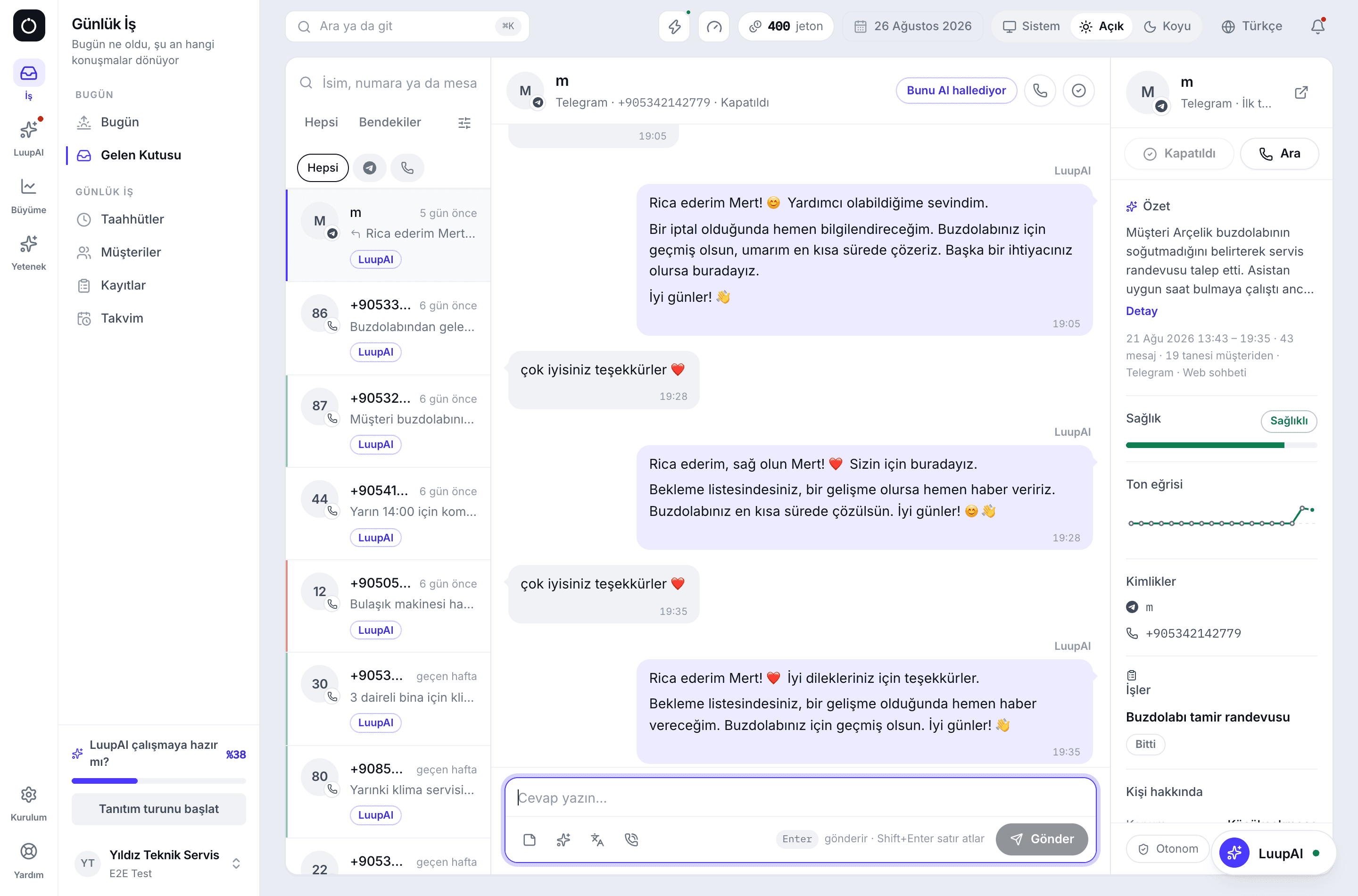
Phone, WhatsApp, web chat, Instagram, e-mail, SMS, Telegram, reviews and marketplace messages meet in one inbox. When a customer switches channel the conversation carries on where it left off — because memory is attached to the person, not the channel. You do not have to change your number.
In short
What is luup and what does it do for a business?
luup is the AI customer-relations and sales system built by Neuros. It gathers conversations from ten channels into one inbox and attaches memory to the person rather than the channel, so a job that starts on the phone continues on WhatsApp without breaking. What the assistant may do without asking you is set from zero to four per channel and per topic, and every outgoing message passes the conversation rules first.
Most tools either collect channels or automate the phone alone. luup collects meaning: it extracts the deep layer a conversation produces — intent, objection, promise made, competitor named — and applies it across every channel. It walks the six-step path from greeting to payment on its own, and at each step you decide how much authority it has.
Modules
What is inside the product
01 · Finding the customer
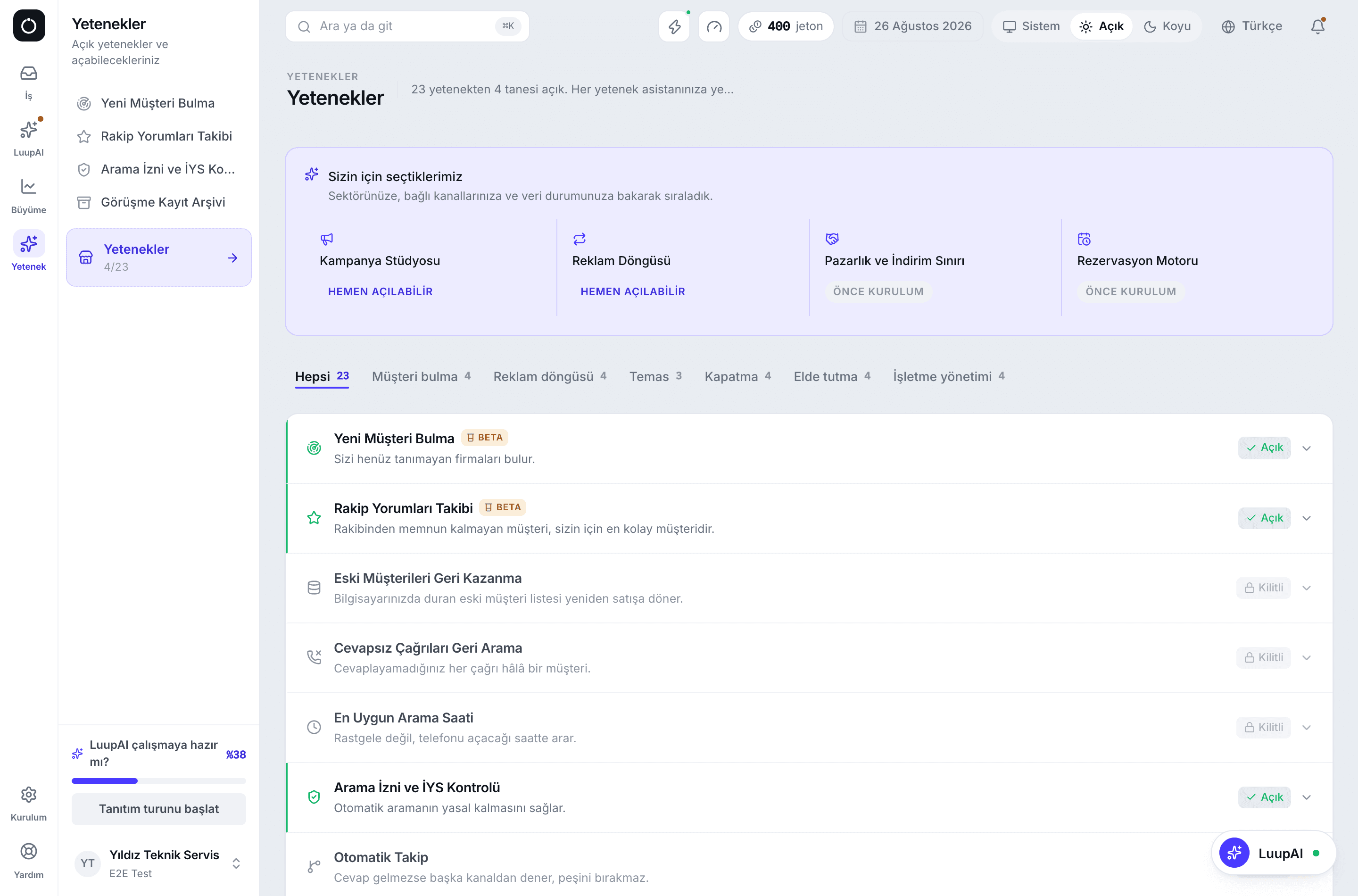
It finds the customer who has not called you yet. It scans needs stated openly in your service area, notices people still searching in negative reviews left for competitors, and calls back dormant customers untouched for 90 days, spread over weeks. Calls you could not answer are listed too — each with the reason the work was missed.
02 · The advertising loop
It does not buy advertising; it trains it. Your Google and Meta accounts connect read-only, and the real value of a closed job is sent back to the platform, so the algorithm starts hunting for people who pay rather than people who fill in forms. Campaign copy is written from sentences that actually closed work, and every campaign is born paused — not a lira is spent until you start it. When your calendar fills up, the budget throttles itself.
03 · Reaching out
It reaches the right person at the right moment on legal ground. Who consented, who withdrew, who was never asked — that check is the real ceiling on every outbound capability, and it cannot be switched off. It calls each person at the hour they actually pick up, and no automated message goes out between 21:00 and 09:00; it is not skipped but deferred to the next morning.
04 · Closing
It turns the conversation into work. The quote reaches the customer before they hang up; an appointment is written into a real gap in the calendar, and when one is cancelled the slot is offered to the first person on the waiting list — not to everyone at once. In negotiation the discount steps are defined and each one asks for something in return; the assistant neither states nor hints at anything below your price floor.
05 · Keeping the customer
It brings the customer back. You define intervals such as "service every 180 days" and the customer whose turn has come appears on the list by itself. Not asking for reviews but earning them: if the conversation ended well it asks for one, and if it ended badly it does not — it opens an internal task to fix the problem instead. Overdue payments are chased politely but persistently.
06 · Running the business
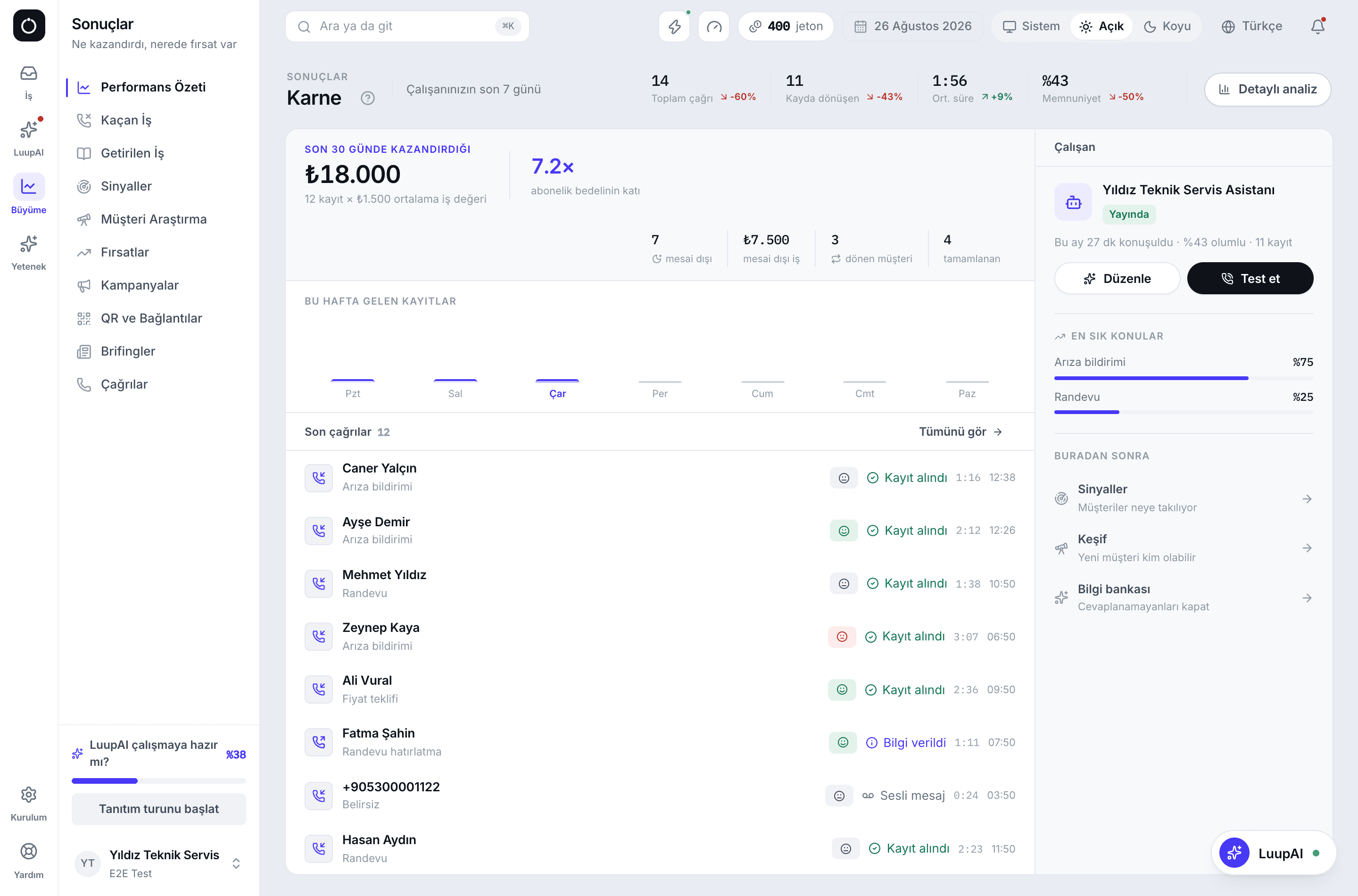
It makes what is happening visible. You learn it without sending a survey: which competitor was named how many times, which objections came up, what was asked for that you do not offer. The call-record archive ends the "that is not what I said" argument; the field team talks and the record fills itself. You can also ask by voice, over the phone, without opening the panel.
Features
You have six customers in six places. Here there is one.
It records by itself
An address, a preference or a vehicle mentioned in conversation is written into the record. Nobody fills in a form afterwards — the customer card fills itself from the conversation.
The channels talk to each other
A job that starts on the phone continues on WhatsApp and the history is not split. Messages within twelve hours land in the same conversation whatever channel they arrive on.
It knows who is calling
The calling number arrives in front of the assistant together with its history. The customer does not explain themselves again, and when the same number turns up on another channel the records merge automatically.
Ask, and the answer is there
Which competitor was named how often, who promised what, what started being asked this period — all searchable. Sentences like "we will call you tomorrow at three" are extracted automatically, and whoever owns them is nudged when they come due.
It does not step outside the rules
You define what may never be said, what may never be promised, the lowest price and any mandatory legal wording. Every outgoing message passes that check — and you can paste a sentence in beforehand to see whether it would get through.
It reads the photograph
From a damage photo sent to a body shop it reads the plate and the damage, states the work and how long it takes, and opens the service record. The same goes for an error code on a boiler, a drug name on a prescription, an amount on an invoice.
Screens
The screenshots come from the product itself — nothing was redrawn for the page.
- 01
- 02
- 03
| Area | luup | Omnichannel inbox |
|---|---|---|
| Customer record | One person above the channels; identities merge automatically | A separate record per channel |
| Switching channel | The conversation carries on where it stopped | New channel, new thread |
| Phone | Voice calls feed the same memory | Usually out of scope |
| Authority | 0–4 per channel and per topic | Either manual or fully automatic |
| Rule enforcement | Every outgoing message is checked before it is sent | Left to guidelines and good intentions |
| Consent | The ceiling on every outbound capability, and it cannot be disabled | Tracked in a separate tool |
| Out of scope | Accounting, stock and field-staff rostering | Varies |
luup works with the line you already have. When your number goes unanswered or is busy, calls are forwarded to the assistant, so the customer always dials the number they know. You can take a separate number through luup if you want one, but it is not required — your printed material, signage and directory listings stay as they are.
In luup the assistant's authority is set from zero to four: at zero it only listens, at two it waits for your approval before sending what it wrote, at four it can book appointments and quote prices. That setting is separate for every channel and every topic. On top of it, each outgoing message passes the conversation rules — your price floor and your forbidden phrases are not left to the model's good intentions but blocked mechanically before sending.
luup does not invent. When it does not know, it says so, tells the customer it will find out and come back, and files the question as a knowledge gap. Those gaps collect in the panel; once you write the answer it becomes a source in the knowledge base and the assistant never stumbles on that question again. It does not volunteer that it is an AI, but it answers honestly when asked.
See it running on your own data
Let's set up a 45-minute live demo in a dedicated environment, using your scenario.